Article II of the “Choosing Yourself Is Not Abandoning Your Children” Series
There is a difference between the lessons we give our daughters and the lessons they watch us live.
We can tell them to be independent. We can tell them to get an education, make their own money, demand respect, leave unhealthy relationships, establish boundaries, travel, take risks, follow their dreams, and refuse to shrink themselves for anyone.
But our daughters are watching us while we say it.
They notice when the advice we give them bears little resemblance to the lives we have created for ourselves. They can tell when we are unhappy. They can tell when we are staying somewhere we no longer want to be, apologizing for things that do not require apologies, allowing people to cross our boundaries, or continually postponing our own lives because someone else might be disappointed.
Children are extraordinarily good at detecting incongruence.
We may tell them one thing, but they absorb what we do.
For a long time, I worried that I had taught my daughter the wrong lessons.
When I became severely ill with COVID and genuinely believed I might die, I began looking backward over my life. One of the realizations that struck me hardest was that I had spent so much time teaching my daughter how to survive in the world that I was not sure I had taught her how to actually live in it.
I had taught her that school mattered. I had taught her to work. I had taught her that bills had to be paid and responsibilities handled. I had tried to teach her to follow rules, meet expectations, and become capable of taking care of herself.
Those things mattered. They still matter.
But lying there, confronting the possibility that my life might end, they suddenly seemed incomplete.
Had I taught her to dream?
Had I taught her to trust herself?
Had I taught her how to walk into an unfamiliar place and believe she would figure things out?
Had I taught her that there was more than one acceptable way to build a life?
I remember thinking that I had taught her to follow rules, but perhaps not to follow her dreams.
That realization hurt because I recognized how much of my own life had been shaped by doing what I believed I was supposed to do. I had spent years trying to satisfy expectations, keep other people happy, and make decisions that seemed responsible or acceptable. I had learned early that sacrificing myself could keep other people comfortable. Motherhood gave me even more reasons to continue doing it.
I did not want that inheritance for my daughter.
And yet, years later, she would tell me that perhaps I had taught her something I did not even know I was teaching.
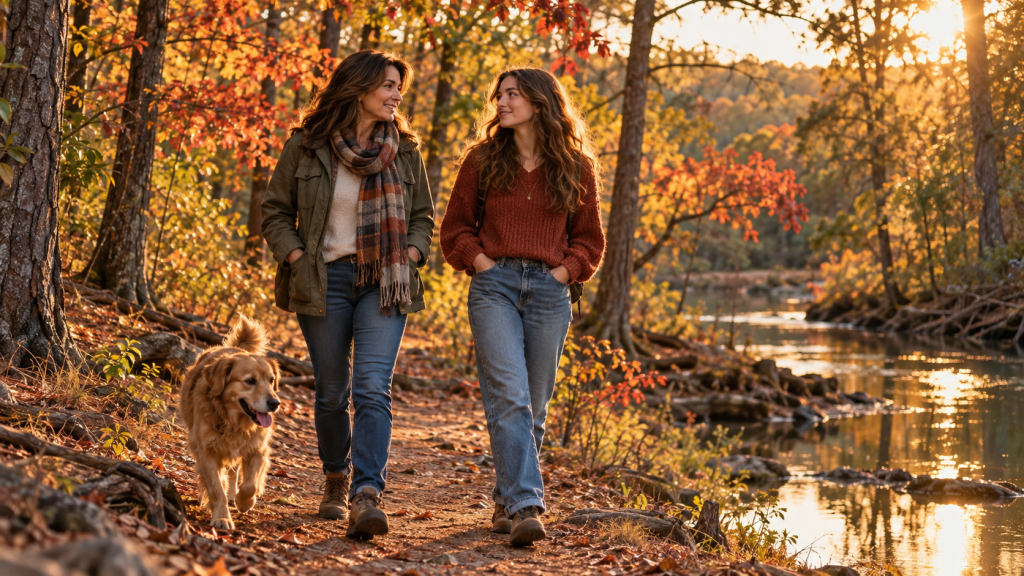
Some time ago, my daughter and I were walking through the woods outside Houston. It was fall, my favorite season, although fall in southeast Texas has always seemed frustratingly brief. The leaves had turned shades of orange, yellow, and red. Pine needles covered parts of the trail. We were walking her dog off-leash beside what I would love to describe as a babbling brook, although honesty requires me to admit that it was really more of a reservoir runoff.
Still, a girl can imagine.
We were talking about my writing and about the possibility that some of our shared history might eventually become part of a book. I wanted to know how she remembered certain parts of her childhood. More importantly, I wanted to give her an opportunity to tell me that she did not want me writing about them.
Our memories belong to us individually, but family stories overlap. Something that was part of my life was also part of hers. I did not want to assume that because I was her mother, I automatically had the right to tell every part of our shared history without considering what it might mean for her.
So we talked about Mexico.
Years earlier, I had made the decision to move there. My daughter was a teenager at the time. It was not her dream.
It was mine.
That distinction matters.
Parents sometimes convince ourselves that because we believe something will ultimately benefit our children, they must experience it the same way we do. They do not. My decision meant something very different to me than it meant to her.
Living in Mexico for those months exposed her to a way of life that differed from the one she had known in Texas. She encountered families with different educational, economic, and social realities, and she began thinking differently about opportunities she had previously taken for granted. She has told me that the experience helped her appreciate the educational choices available to her in the United States in a way that my lectures about school had never managed to accomplish.
That is one of the humbling things about parenting. Sometimes we spend years explaining something to our children and get nowhere. Then life teaches the lesson in five minutes.
But Mexico taught her something else too.
She saw me follow a dream.
When we talked during that walk years later, she told me that although moving to Mexico had never been her dream, she understood that it was mine. And somehow, watching me pursue it helped her understand that she needed to pursue her own.
Her dream, at that moment, required leaving mine.
She was seventeen when she wanted to return to the United States, but I was scared. Part of my fear was reasonable. She was young. I worried about her safety. I worried about what could happen when I was not there. I worried about violence in the United States, about the thousand unpredictable things parents imagine once their children move beyond the radius of our immediate protection.
But if I am honest, that was not all of it.
I wanted her with me because having her close made me feel safer.
If she was with me, I could see her. I could know where she was. I could step in when something happened. I could feel as though I still had some control over the enormous uncertainty that comes with loving another human being.
And I did not want to be alone.
Those feelings were real too.
One of the most difficult parts of motherhood is distinguishing between protecting our children and managing our own fear. The two can feel almost identical from the inside.
We tell ourselves that we know better because we are older. We imagine everything that could go wrong. We call our decisions protection because protection sounds noble, while control sounds selfish.
Sometimes the decision really is about safety. Parents have responsibilities, particularly when our children are young.
But sometimes we have to ask ourselves a much harder question:
Am I asking my child not to do this because the danger is unreasonable, or because allowing it requires me to tolerate fear?
That kind of honesty is uncomfortable.
When my daughter told me she wanted to return to the United States, I wanted to keep her with me. But I also knew what it felt like to believe that the people you loved were asking you to surrender your own life in order to make them comfortable.
I knew what it felt like to postpone dreams.
I knew what resentment could grow from living according to someone else’s expectations.
How could I tell my daughter to trust herself and then insist that she ignore herself because her decision frightened me?
She told me she was ready.
She told me she wanted the challenge.
She believed she would figure things out.
And eventually, I had to respect that.
What surprised me years later was hearing how she understood that decision.
She did not describe herself simply as a seventeen-year-old whose mother had allowed her to leave. She described someone beginning to claim sovereignty over her own life.
She knew she wanted to return to the United States even though she did not know exactly what would happen afterward. She trusted that things would work themselves out and that she would find her way.
I recognized that feeling immediately.
It was the same kind of knowing that had led me to Mexico.
There are decisions in life that can be difficult to explain because they are not entirely rational calculations. You can make lists. You can analyze risks. You can talk yourself in circles. Yet somewhere underneath all of that, there is sometimes a quiet certainty: This is what I need to do.
Following that certainty does not eliminate fear. Often it creates more of it.
There is something terrifying about choosing a life because it is genuinely yours. If you follow the conventional path and things go wrong, you can at least tell yourself that you did what you were supposed to do. But when you step away from that path and pursue something because it feels true to you, failure can feel much more personal.
You chose it.
You claimed it.
You cannot blame the script.
And yet, in my own life, I have often found that when I stop fighting against what I know to be true for me, things begin moving differently. That does not mean life becomes easy. It certainly has not made mine easy. But there is a difference between facing challenges while moving toward your own life and facing challenges while trapped inside one you never truly chose.
I wanted my daughter to know that difference.
What I had not fully understood was that she may have learned it simply by watching me.
This is why I believe daughters often absorb the lives their mothers live more deeply than the advice their mothers give.
A mother can tell her daughter never to tolerate an unhealthy relationship, but if the daughter watches her remain in one for decades, that relationship becomes part of the daughter’s education.
A mother can tell her daughter to set boundaries, but if she apologizes every time she establishes one herself, the daughter notices.
A mother can tell her daughter to be financially independent while organizing her own life around another person’s permission.
She can tell her daughter to travel while repeatedly postponing every place she wants to see.
She can tell her to follow her dreams while treating her own dreams as childish luxuries that responsible women eventually outgrow.
Our daughters can smell the contradiction.
They also feel the resentment that sometimes grows from it.
When a woman gives up nearly everything for her children because she believes motherhood requires it, those sacrifices do not simply disappear. Years later, they may surface in sentences like, “After everything I have done for you,” or, “I gave up my entire life for you.”
Perhaps no child ever asked her to do that.
Perhaps she believed she was loving them.
Perhaps she was loving them.
But love does not prevent resentment from growing when a person continually violates her own needs.
And our daughters feel that resentment, even when we never name it.
That is why I have come to believe that one of the most important things a mother can give her daughter is the opportunity to see her as a whole person.
Not an invisible support system.
Not a woman whose only interests are her children’s interests.
A person.
I want my daughter to know that I am her mother, but I am also many other things. I can be a reader, a writer, a yogi, a student, a professional, a traveler, a wife, a friend. I can discover new interests at forty or fifty or sixty. I can change my mind. I can make mistakes. I can start over.
I can love her without making her the sole purpose of my existence.
That matters because I do not want her to grow up believing that becoming a mother someday would require the death of every other identity she has built.
I want her to understand that motherhood can become one part of a woman’s identity without consuming the entire woman.
And I want our sons to learn that too.
A boy who grows up watching his mother carry everyone around her may absorb the idea that this is simply what women do. Women remember. Women accommodate. Women anticipate. Women organize. Women sacrifice. Women bend.
Then we wonder why he eventually expects the women in his adult life to do the same.
If we want our children to build healthier relationships, perhaps we have to let them witness women having needs.
They need to hear us say no.
They need to watch us pursue interests that have nothing to do with them.
They need to see us make decisions that other people do not always understand.
They need to see us apologize when we are wrong without apologizing for existing.
They need to see that loving someone deeply does not mean surrendering ownership of your own life.
My daughter and I have very different lives.
That is precisely how it should be.
She did not watch me move to Mexico and decide that therefore she needed to live in Mexico too.
That would not have been the lesson.
She saw me make a choice because something inside me told me that I needed to make it.
And later, when something inside her told her that she needed to leave, she listened.
The inheritance was not Mexico.
The inheritance was permission.
Permission to trust herself.
Permission to choose differently from me.
Permission to believe that loving someone does not require living the life they would choose for you.
I once feared that I had taught my daughter only how to follow rules.
Years later, walking together through those fall leaves, I realized that perhaps she had been learning something else all along.
Maybe our children learn from our failures.
Maybe they learn from the things we repair.
And maybe they learn from watching us finally become brave enough to live differently.
I cannot tell my daughter exactly what kind of life she should build.
I should not.
Her life belongs to her.
But I can show her what it looks like to keep asking whether the life I am living actually belongs to me.
And perhaps that is one of the greatest things mothers can model for their daughters.
Not perfection.
Not sacrifice without limits.
Not a life without mistakes.
But the courage to belong to ourselves.
Because our daughters are watching.
And sometimes, when we finally give ourselves permission to follow our own lives, they learn that they are allowed to follow theirs.


Leave a Reply