-

Article II of the “Choosing Yourself Is Not Abandoning Your Children” Series There is a difference between the lessons we give our daughters and the lessons they watch us live. We can tell them to be independent. We can tell them to get an education, make their own money, demand respect, leave unhealthy relationships, establish…
-

Article I of the “Choosing Yourself Is Not Abandoning Your Children” Series There is something almost accusatory in the question because women are taught, sometimes explicitly and sometimes through a thousand small messages, that once we become mothers, choosing ourselves means choosing ourselves over our children. A good mother sacrifices. A good mother puts her…
-

The content discusses the impact of traumatic childhood experiences on personal development, emphasizing that survivors often lack essential self-advocacy skills. It highlights the importance of learning rights such as setting boundaries and trusting oneself, arguing that true healing involves not only understanding trauma but also actively practicing self-advocacy.
-
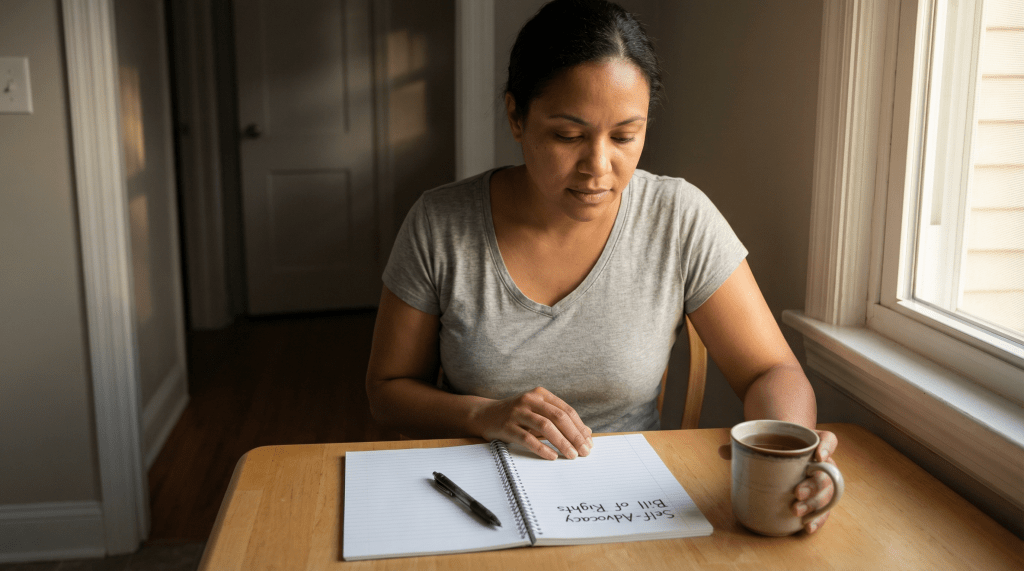
Self-advocacy in domestic violence can be perilous, contrary to popular belief. While acknowledging universal rights, the SABOR framework emphasizes the need for mindful, strategic approaches to self-advocacy within abusive contexts. Survivors must evaluate risks and often act quietly to reclaim power, prioritizing safety and internal validation over external expressions.
-

The author critiques conventional discussions about boundaries, emphasizing that many women struggle to set them due to deep-seated conditioning rather than personality flaws. Boundaries should be viewed as rights protecting individual well-being. The piece advocates for recognizing guilt as a response to changing behaviors, not a sign of wrongdoing, and offers practical approaches to boundary-setting.
-

And How to Start You already know how this goes. Someone asks you to take on an extra project, cover a shift, chair a committee, host the family dinner, absorb one more thing — and before your brain has fully processed the question, you hear your own voice say: “Sure. No problem.” Then comes the…
-

There is a particular kind of silence that grows in chaotic homes — not the peaceful kind, but the kind that is enforced. The kind where children learn, very early, that having a voice is dangerous. That needing things is inconvenient. That wanting to be seen, heard, or protected is a burden too heavy for…
-

A woman who survives an extreme childhood is not broken by it; she is recalibrated by it. Branded “difficult,” she is often simply a woman who learned early that survival depends on refusing to be controlled. This essay argues that such women are not defects of femininity but living proof that self-advocacy and boundaries are…
-

Announcing Self-Advocacy Foundations, a 5-week course built on the SABOR framework to help you set boundaries, speak up, and advocate for yourself. You had the perfect thing to say. You knew it in the moment. The meeting was happening, the conversation was unfolding, and you could feel the words forming — and then something stopped…
-
When “Family First” is Dangerous There’s a script many of us grow up with:“Blood is thicker than water.”“Family is all you’ve got.”“You only get one mother.” Those phrases sound noble—until you grow up in a family that is abusive, unsafe, and fundamentally not to be trusted. In families like mine, clinging to those beliefs is…

